
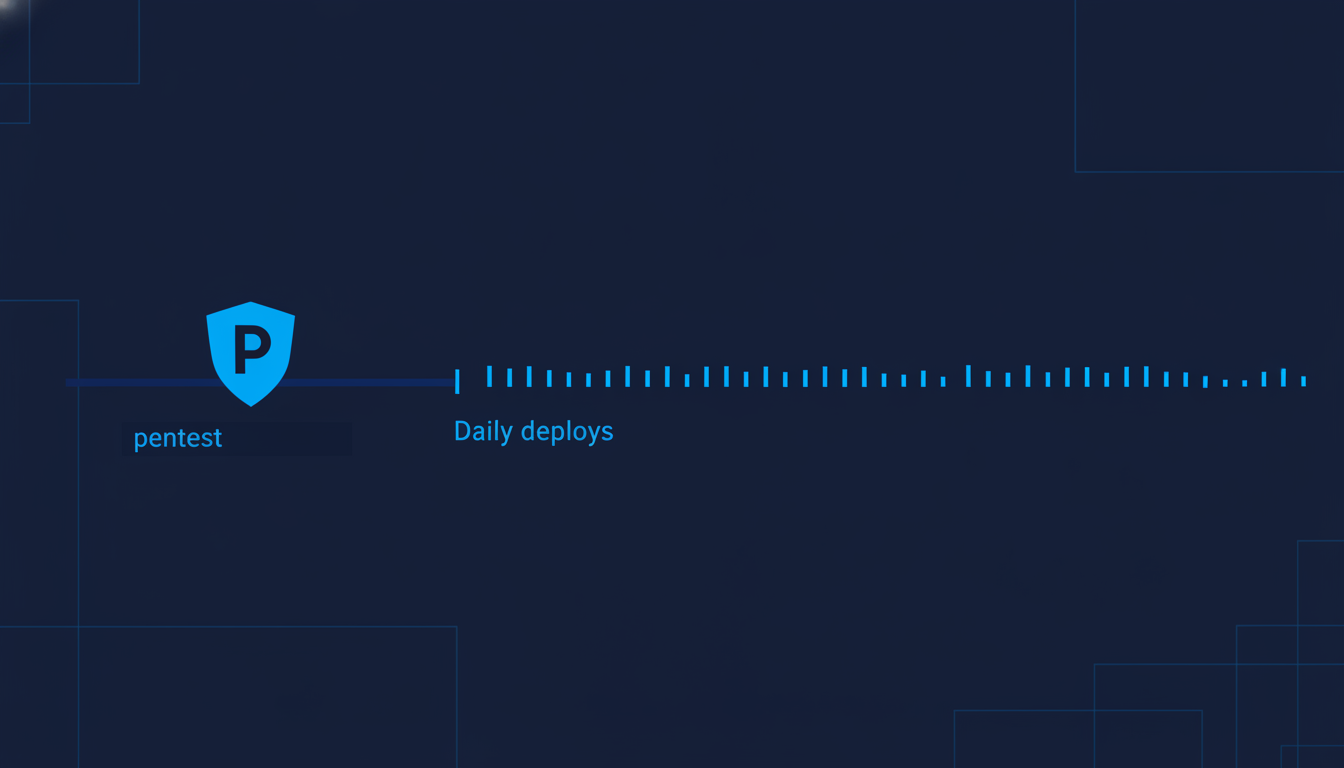
Your last penetration test evaluated an application that no longer exists.
That's not a criticism of the testers. It's arithmetic. If your team shipped code last week — and the week before, and the week before that — then the application your pentesters examined has been replaced, piece by piece, by something they never saw.
The security industry has spent years debating whether automated testing can match human testers. That's the wrong debate. The real problem isn't the quality of the test. It's the calendar.
Code ships daily now
Software delivery has been accelerating for a decade, and AI-assisted development just hit the accelerator again. DORA's research program — the largest ongoing study of software delivery performance — has long found that high-performing teams deploy on demand, multiple times per day, and its 2025 State of AI-assisted Software Development report documents how widely AI has been absorbed into everyday engineering work.
You can see it in your own organization. Features that took a quarter now take a sprint. Internal tools that nobody would have built ("not worth the engineering time") get built in an afternoon. The backlog moves.
This is good news. It's also a security event that most testing programs haven't priced in.
Every deploy is an attack surface change
An attack surface isn't a fixed thing you can measure once. It's the sum of every endpoint, parameter, integration, permission check, and piece of business logic exposed to the outside world — and it changes every time you ship.
A new API route. A modified authorization check. A third-party integration added to close a deal. A quick internal dashboard that quietly ended up internet-reachable. None of these appear in last quarter's pentest report, because none of them existed last quarter.
Development velocity and attack surface churn are the same number wearing different hats. If you ship daily, your attack surface changes daily. There is no way to accelerate one without accelerating the other.
Attackers sped up too
If defenders got AI leverage, so did attackers. CrowdStrike's 2026 Global Threat Report describes an 89% increase in attacks by AI-enabled adversaries — its assessment is that AI-driven threats have reached a turning point. Check Point's telemetry showed global attack volumes up 17% year-over-year as of June 2026, with AI-related risks and ransomware still climbing.
The direction of both curves matters more than any single number: attacks are getting more frequent and cheaper to run at exactly the moment attack surfaces are changing faster than ever. Reconnaissance that once took an attacker days — mapping your endpoints, fingerprinting your stack, probing for the seams — is increasingly automated. Attackers are, in effect, continuously testing your attack surface. The only party still working annually is your testing program.
The math
Here's the structural problem, with deliberately simple, illustrative numbers.
Say your team deploys twice per weekday — modest by modern standards. That's roughly 500 deploys a year. An annual pentest examines your application on one of those 500 versions. Every finding is real and worth fixing — for the version tested. The other 499 versions ship into production with zero adversarial validation.
Now stretch the timeline. A vulnerability introduced the week after your pentest lives in production for roughly 51 weeks before the next test has a chance to catch it. During those 51 weeks, the AI-accelerated attacker ecosystem described above gets unlimited attempts.
This is why the velocity gap is a math problem and not a quality problem. Hiring a better pentest firm improves the quality of the snapshot. It does nothing about the 499 untested versions. You cannot fix a cadence problem with talent.
What this doesn't mean
It doesn't mean annual pentests are worthless. Compliance frameworks like SOC 2 and PCI-DSS expect them, auditors know how to consume them, and a skilled human red team will find things no automated system will. If your auditor wants an annual pentest, keep doing your annual pentest.
It also doesn't mean pentesters are the problem. The people are excellent. The engagement model — scope, quote, schedule, test for two weeks, report, repeat in a year — was designed for a world where applications changed slowly. That world is gone.
Closing the gap
The fix follows directly from the diagnosis: if the attack surface changes continuously, testing has to run continuously. Not continuous scanning — scanners generate thousands of theoretical findings, most of them false positives, which trades a coverage gap for a noise problem. Continuous testing: actually attempting exploitation against the application as it exists today, and reporting only what's proven to work, with evidence.
That's the model EdgeBreach was built for — AI-driven penetration testing that runs as often as you ship, validates exploitability instead of reporting possibilities, and treats the annual pentest as a compliance complement rather than a competitor. The testing cadence finally matches the shipping cadence, and the velocity gap closes.
Your attack surface changes daily. Your pentest was months ago. The question worth asking your team isn't "was our last pentest any good?" It's "how much have we shipped since — and who's tested it?"
EdgeBreach is an AI-native penetration testing platform. If you'd like to see what continuous, exploitation-validated testing finds in your environment, request a demo.
Sources
- DORA, 2025 State of AI-assisted Software Development Report — cloud.google.com
- DORA, software delivery performance metrics — dora.dev
- CrowdStrike, 2026 Global Threat Report — crowdstrike.com
- Check Point Research June 2026 data, via InfotechLead — infotechlead.com